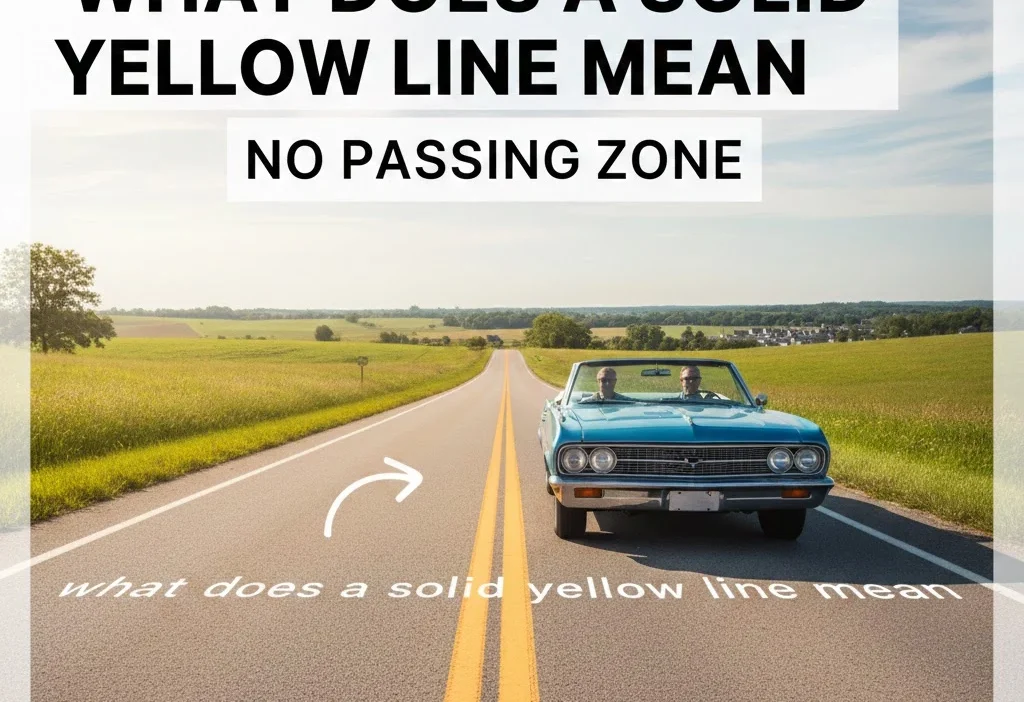
Have you ever been driving and noticed a solid yellow line in the middle of the road and suddenly wondered, “Am I allowed to pass here or not?” You’re not alone. Many drivers feel unsure about road markings, especially when traffic situations change quickly. A small mistake around road lines can lead to fines, accidents, or even license points.
If you’re searching what does a solid yellow line mean, this guide explains everything in simple language. You’ll learn the exact meaning, when you can cross it, when you must not, real driving examples, common mistakes, and safety tips. By the end, you’ll understand solid yellow lines with confidence.
Quick Answer:
A solid yellow line means no passing in most situations. It separates traffic moving in opposite directions and warns drivers that crossing or overtaking is unsafe.
🧠 What Does a Solid Yellow Line Mean?
A solid yellow line is a traffic control marking painted on roads to guide drivers and prevent accidents. It usually appears in the center of the road and indicates that passing or crossing is restricted because visibility or road conditions make it dangerous.
Key meaning in simple terms:
- Solid yellow line = Do NOT pass
- Used where passing would be unsafe
- Separates traffic moving in opposite directions
Example:
If you’re driving behind a slow vehicle and see a solid yellow line next to you, you must stay in your lane and wait.
In short:
Solid yellow line = No passing = Increased risk area
🚗 Why Are Solid Yellow Lines Used?
Solid yellow lines exist to protect drivers and pedestrians. They are placed in areas where passing could cause head-on collisions or loss of control.
Common reasons you’ll see solid yellow lines:
- Sharp curves
- Hills with limited visibility
- Narrow roads
- Busy intersections
- School or residential zones
- Areas with frequent accidents
Traffic engineers study road conditions before placing these markings. When you see a solid yellow line, it’s there because drivers can’t safely see oncoming traffic.
🌍 Where Will You Commonly See Solid Yellow Lines?
Solid yellow lines appear in many driving environments:
- 🛣️ Two-lane highways
- 🚗 Rural roads
- 🏘️ Residential streets
- 🏫 School zones
- 🌄 Hilly or mountainous roads
- 🔄 Curves and blind turns
Formal or casual?
- Formal traffic rule
- Enforced by law
- Ignoring it can result in fines or penalties
🚦 Types of Yellow Lines You Should Know
Understanding variations helps avoid confusion.
1️⃣ Single Solid Yellow Line
- No passing in either direction
- Common on two-way roads
2️⃣ Double Solid Yellow Lines
- Stronger warning
- No passing at all
- No lane changes
3️⃣ Solid Yellow + Broken Yellow
- Broken side may pass
- Solid side must not pass
| Line Type | Can You Pass? |
|---|---|
| Single Solid Yellow | ❌ No |
| Double Solid Yellow | ❌ No |
| Broken Yellow | ✅ Yes (if safe) |
| Solid + Broken | One side only |
💬 Real Driving Examples Using Solid Yellow Lines
- Behind a slow truck on a curve
→ Solid yellow line means wait patiently. - Approaching a hill
→ You can’t see ahead, so no passing. - Residential street with solid yellow
→ Protects children and pedestrians. - Mountain road turn
→ Prevents head-on crashes. - Near an intersection
→ Keeps traffic predictable.
🕓 When Can You Cross a Solid Yellow Line?
This surprises many drivers: sometimes you can cross it, but only for specific reasons.
✅ Allowed situations:
- Turning left into a driveway or side road
- Making a U-turn (where legal)
- Avoiding an obstacle (only if safe and legal)
- Emergency situations
❌ Not allowed:
- Overtaking slower vehicles
- Passing for convenience
- Beating traffic
- Ignoring it because “the road looks clear”
Discover Related Articles:-
- What Does The “Ants??” Emoji Mean? 🐜🤔 Explained Clearly
- What Does >�ソスy�ソス Mean in Text? 🤔 Explained Clearly
- What Does Estimated Delivery Mean? 📦 Clear Explanation for Online Shoppers
⚠️ Common Mistakes Drivers Make
Many accidents happen due to misunderstanding solid yellow lines.
Common errors:
- Passing because “no cars are coming”
- Crossing double solid yellow lines
- Confusing yellow with white lines
- Ignoring markings at night
- Following another driver who breaks the rule
Remember: Road markings are laws, not suggestions.
📊 Solid Yellow Line vs Other Road Lines
| Line Color | Meaning |
|---|---|
| Yellow | Opposing traffic |
| White | Same direction traffic |
| Solid White | Lane discipline |
| Broken White | Lane change allowed |
| Double Yellow | Strong no-pass warning |
🛑 Penalties for Ignoring a Solid Yellow Line
Breaking solid yellow line rules can lead to:
- Traffic tickets
- Fines
- License points
- Increased insurance rates
- Serious accidents
In many regions, illegal passing across a solid yellow line is considered reckless driving.
🌎 Does the Meaning Change by Country?
The meaning is mostly universal, but penalties may vary.
United States
- Solid yellow = No passing
- Enforced strictly
Canada
- Same meaning
- Heavy fines for violations
UK
- Known as double yellow center lines
- Strict enforcement
Australia
- Same rules apply
In short:
Solid yellow lines mean danger worldwide.
🙋♂️ FAQs About Solid Yellow Lines
1. Can I pass if there’s no traffic?
No. Visibility rules still apply.
2. Can I cross it to turn left?
Yes, if legal and safe.
3. What if another driver passes me?
Do not follow them.
4. Is a solid yellow line always enforced?
Yes, even if police aren’t visible.
5. Does weather affect the rule?
Bad weather makes the rule even more important.
6. Is a double solid yellow more serious?
Yes, it strongly prohibits passing.
7. Can motorcycles cross it?
No special exception unless local law allows.
8. What if the line is faded?
Rules still apply.
📝 Mini Quiz – Test Your Road Knowledge
1. What does a solid yellow line mean?
a) Passing allowed
b) No passing ✅
c) Speed up
2. Can you cross a solid yellow line to overtake?
a) Yes
b) No ✅
c) Only at night
3. Where are solid yellow lines commonly placed?
a) Safe passing zones
b) Dangerous areas ✅
c) Parking zones
4. Which line separates opposite traffic?
a) White
b) Yellow ✅
c) Blue
5. Is it legal to cross for a left turn?
a) Never
b) Yes, if safe ✅
c) Only on highways
📝 Conclusion
A solid yellow line is one of the most important road safety markings. It tells drivers that passing is unsafe and could lead to serious accidents. Whether you’re driving on a highway, residential street, or mountain road, respecting this line protects you, passengers, and oncoming drivers.
Now that you know what a solid yellow line means, you can drive with confidence, avoid fines, and stay safe on the road.