Imagine hearing someone say, “He was sentenced… but didn’t go to jail.” Confusing, right? That’s often what people mean when they mention a suspended sentence. You may see this term in news headlines, crime podcasts, or court dramas, but most people are unsure what it actually means.
Whether you’re curious about legal terminology, studying criminal law, or just ran into this phrase on the internet, this guide breaks it down in simple, everyday language — with examples, tables, FAQs, and even a quiz.
Quick Answer:
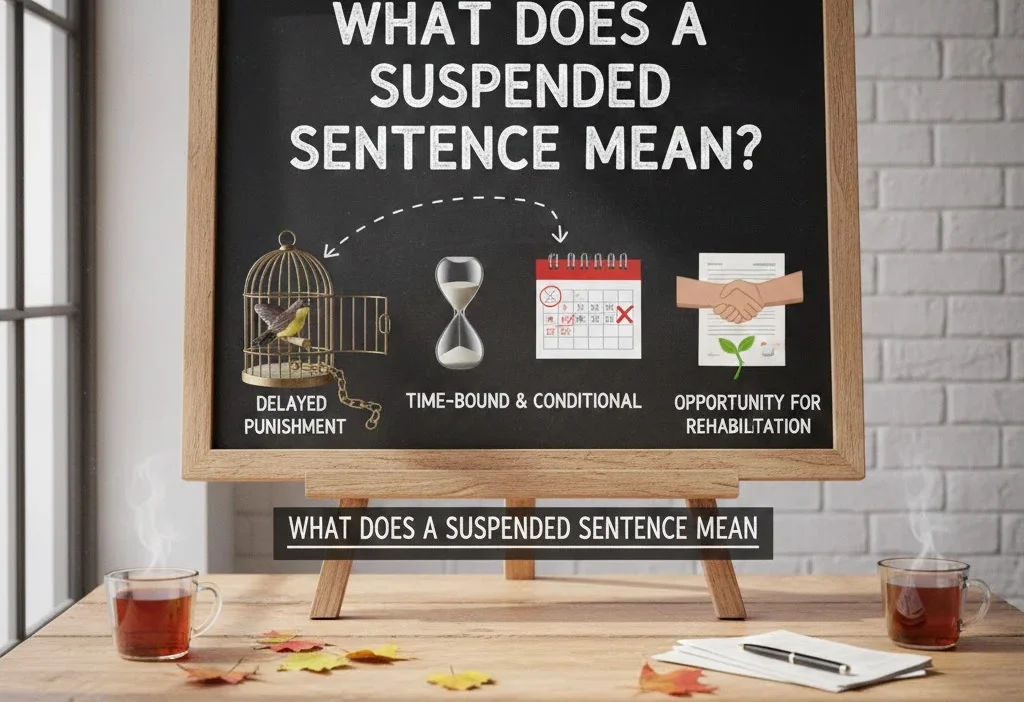
A suspended sentence means a judge gives a jail or prison sentence, but delays enforcing it. The person won’t go to jail unless they break certain rules (like reoffending). It’s like a warning with conditions.
🧠 What Does a Suspended Sentence Mean in Legal Terms?
A suspended sentence means the court decides on punishment but pauses it, often to give someone a chance to prove they can follow laws and stay out of trouble.
The judge may say, for example:
“You are sentenced to 6 months, but the sentence is suspended.”
That means:
- The sentence exists
- But the person does not serve time unless they violate conditions
In everyday words:
It’s like the court saying, “We’re watching you — behave, and you stay free.”
Example Sentence:
“He got a suspended sentence, so he won’t go to jail unless he breaks the law again.”
🔍 In short:
Suspended Sentence = Punishment decided but not carried out unless violated.
📝 Types of Suspended Sentences
There are two main types:
✔️ 1. Fully Suspended Sentence
- The entire jail term is suspended
- The person serves no jail time
- They must follow conditions (probation, no new crimes, etc.)
✔️ 2. Partially Suspended Sentence
- Part of the sentence must be served
- The rest is suspended
Example:
Sentence = 12 months
Must serve = 4 months
Suspended = 8 months
📌 Why Do Judges Give Suspended Sentences?
Judges use suspended sentences when they believe:
- The person learned from their mistake
- The offense is not severe enough for prison
- The person is unlikely to reoffend
- Jail would be too harsh
- Rehabilitation is possible
📱 Real-Life Examples (Understanding Context)
- A first-time offender for a minor theft might receive a 1-year suspended sentence.
- Someone involved in a bar fight may get a suspended sentence and anger-management classes.
- A person with drug possession might avoid jail if they complete treatment.
⚖️ Suspended Sentence vs. Probation (Comparison)
Many people confuse these — here’s the difference:
| Term | Meaning | Jail Time? |
|---|---|---|
| Suspended Sentence | Jail is ordered but paused | No (unless violated) |
| Probation | Supervised behavior instead of jail | No (unless violated) |
📩 Conditions Attached to Suspended Sentences
The court may require:
- No involvement in new crimes
- Regular reporting to probation officers
- Community service
- Drug or alcohol treatment
- Staying away from certain places or people
- Counseling or anger management
If ANY of these conditions are violated → Jail time starts.
❌ When a Suspended Sentence Can Be Revoked
A suspended sentence may be canceled if the person:
- Commits another crime
- Violates probation
- Breaks court orders
- Fails drug tests
- Avoids treatment or classes
Once revoked, they may be required to serve the original jail sentence.
⚖️ Example Scenarios in Real Court Style
- Shoplifting (First Offense)
Judge: 90 days suspended → No jail if no new crimes - DUI (Alcohol Offense)
Judge: 6 months suspended + rehab - Assault (Minor Harm)
Judge: 1 year suspended + anger management - Drug Possession
Judge: 1 year suspended + drug treatment - Violation Later
If they reoffend → They serve the original sentence
🕓 When a Suspended Sentence Is Commonly Used
✔️ Common Situations
- First-time offenders
- Non-violent crimes
- Youth cases
- Minor theft or fraud
- Low-level drug possession
❌ Rare Situations
- Serious violent crimes
- Repeat offenders
- Sexual offenses
- Homicide cases
📊 Suspended Sentence vs Prison vs Fine (Comparison Table)
| Situation | Suspended Sentence | Prison Sentence | Fine |
|---|---|---|---|
| Goes to jail? | No (unless violated) | Yes | No |
| Given by judge? | Yes | Yes | Yes |
| Conditions required? | Yes | No | Sometimes |
| Used for serious crimes? | Rare | Yes | No |
| Goal | Rehabilitation | Punishment | Penalty |
⛔ Common Misconceptions
| Myth | Reality |
|---|---|
| “Suspended means not guilty.” | False — they ARE guilty. |
| “Suspended means erased.” | No — it stays on record. |
| “It can’t lead to jail.” | It can, if violated. |
🙋 FAQs: Suspended Sentence Explained
❓ Does a suspended sentence mean you don’t go to jail?
Yes — unless you break the rules.
❓ Does it stay on your criminal record?
Yes, it still counts as a conviction.
❓ Is it the same as probation?
No — probation monitors behavior; suspension postpones jail.
❓ Can it be removed later?
In some places, yes, after time and good conduct.
❓ Is it common?
Yes, especially for first-time, non-violent offenders.
📝 Mini Quiz — Test Yourself!
1. A suspended sentence means:
a) You go directly to jail
b) You avoid jail unless you violate rules ✅
c) You are innocent
2. A suspended sentence is given when:
a) You reoffend
b) Jail is too harsh for the situation ✅
c) You want it
3. If you break the conditions of a suspended sentence:
a) Nothing happens
b) You pay a fine
c) You may go to jail ✅
4. Suspended sentences are often used for:
a) First-time offenders ✅
b) Murder cases
c) Kidnapping
5. A suspended sentence stays on your record:
a) Yes ✅
b) No
c) Only if you ask
🏁 Conclusion
A suspended sentence is a way for courts to say,
“You’re guilty, but we’re giving you a chance.”
It avoids jail now, but jail becomes possible if the person reoffends. That’s why it works as both a warning and rehabilitation opportunity.
Understanding these terms makes news reports, legal cases, and court stories much easier to follow — and now you know exactly what it means when someone says, “He got a suspended sentence.”