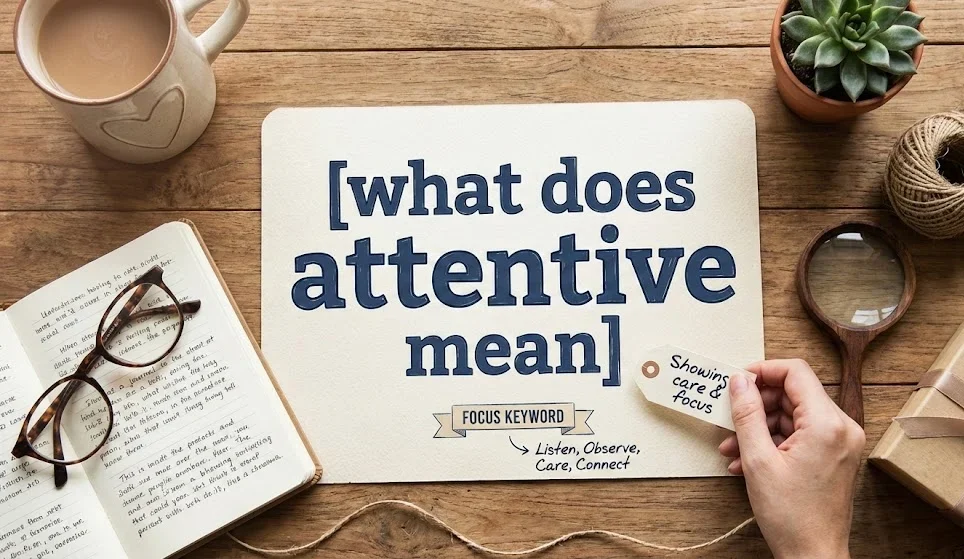
Have you ever been told someone is attentive, or wondered what it truly means to be attentive in conversation, work, or relationships? If you’ve searched “what does attentive mean”, you’re in the right place. Understanding this word not only helps you in communication but also in self-improvement and social awareness.
In this guide, you’ll learn what attentive means, its full definition, synonyms, examples in real life, when to be attentive or not, common mistakes, similar words, FAQs, and even a mini quiz. By the end, you’ll know how to use it confidently in conversations, work, and everyday life.
Quick Answer:
Attentive means “paying close attention” or being alert, considerate, and thoughtful. It’s a positive word often used to describe someone who notices details, listens carefully, or cares about others’ needs.
🧠 What Does Attentive Mean?
The word attentive comes from the Latin attentus, which means “to stretch toward” or “to heed.” In modern English, it describes someone who is focused, alert, and considerate of what’s happening around them.
Key aspects of being attentive:
- Awareness: Noticing details others might miss
- Listening: Paying careful attention in conversations
- Consideration: Being thoughtful of others’ needs
- Responsiveness: Reacting appropriately to situations
Example in a sentence:
“She was very attentive during the meeting, taking notes and asking thoughtful questions.”
In short:
Attentive = Paying close attention = Being alert, considerate, and focused.
Whether in work, study, or personal relationships, being attentive is often seen as a valuable trait.
🌍 Different Contexts for Attentive
Attentive is versatile and can be used in multiple contexts:
1. Work / Professional Settings
- Listening carefully during meetings
- Noticing small errors or improvements
- Being responsive to coworkers or clients
Example:
“The attentive staff ensured every guest had a comfortable stay.”
2. Education / Learning
- Students who focus and engage in class
- Teachers who notice students’ progress
Example:
“He was attentive in class, asking questions and following instructions carefully.”
3. Relationships / Social Life
- Being thoughtful about friends’ or partners’ needs
- Listening actively and noticing emotions
Example:
“She’s always attentive to her friends’ feelings and offers help whenever needed.”
4. General Awareness
- Observing surroundings carefully
- Paying attention to details in tasks or safety
Example:
“Drivers need to be attentive while on busy roads.”
📱 Synonyms and Similar Words
Using synonyms can make your language more dynamic. Some common synonyms for attentive:
| Synonym | Meaning | When to Use |
|---|---|---|
| Observant | Notices details easily | Everyday, professional |
| Alert | Quick to notice changes or dangers | Work, safety |
| Mindful | Aware of actions and consequences | Mindfulness, relationships |
| Thoughtful | Caring about others’ needs | Personal relationships |
| Careful | Taking care, precise | Work, tasks |
| Considerate | Respectful of others | Social situations |
💬 Examples of Attentive in Conversation
- A: Did you notice the new rules at work?
B: Yes, I was attentive during the training. - A: I feel like no one listens to me.
B: Don’t worry, I’m attentive and I hear you. - A: Can you check the details again?
B: Of course, I’ll be attentive to every point. - A: How was the hotel service?
B: Very good, the staff was extremely attentive. - A: Did you see the changes in the report?
B: Yes, I was attentive while reviewing it. - A: Are you paying attention?
B: Yes, I’m very attentive to what you’re saying.
🕓 When to Be Attentive and When Not
✅ When to Be Attentive
- During conversations and meetings
- When learning something new
- In safety-critical situations
- While helping someone who needs support
- When giving feedback or guidance
❌ When Not to Be Overly Attentive
- Avoid being overly critical of small details in casual settings
- Don’t invade privacy by noticing too much
- Avoid interrupting by over-analyzing others
- In relaxed social contexts, focus on connection rather than observation
Comparison Table
| Context | Example Phrase | Why It Works |
|---|---|---|
| Work Meeting | “She was attentive and took detailed notes.” | Shows focus & professionalism |
| Classroom | “He is attentive in class, always asking questions.” | Indicates engagement |
| Social | “He’s attentive to his friends’ feelings.” | Reflects empathy & thoughtfulness |
| Driving | “Stay attentive on the road.” | Critical for safety |
🔄 Similar Words or Alternatives
| Word | Meaning | When to Use |
|---|---|---|
| Observant | Notices fine details | Professional, everyday |
| Mindful | Aware of feelings or actions | Personal relationships |
| Alert | Quick to respond | Safety, work, emergency |
| Considerate | Respectful and thoughtful | Social situations |
| Focused | Concentrated on task | Work, study |
| Thoughtful | Caring & considerate | Relationships |
🙋♂️ FAQs About Attentive
1. Is attentive always positive?
Yes, it generally describes a good quality, though being overly attentive can sometimes be intrusive.
2. Can attentive describe both people and actions?
Yes, it can describe a person’s behavior or their attention to tasks.
3. What is the opposite of attentive?
Inattentive, careless, distracted, or negligent.
4. Is attentive formal or casual?
It’s versatile — can be used in professional, educational, or casual conversations.
5. Can attentive be used in writing?
Absolutely — it’s commonly used in reports, essays, and evaluations.
6. How do I sound attentive in conversation?
Listen actively, nod, ask questions, and respond thoughtfully.
7. Is attentive a personality trait?
Yes, it’s often considered part of someone’s demeanor or habit.
📝 Mini Quiz – Test Your Knowledge
1. What does attentive mean?
a) Ignoring details
b) Paying close attention ✅
c) Rushing tasks
2. Which of these is a synonym of attentive?
a) Careless
b) Observant ✅
c) Distracted
3. In which context would you NOT need to be attentive?
a) Casual social hangout ✅
b) Safety-critical work
c) Classroom
4. Which of these describes someone attentive?
a) Notices small details ✅
b) Talks without listening
c) Ignores instructions
5. What is the opposite of attentive?
a) Inattentive ✅
b) Mindful
c) Considerate
6. Which example shows attentive behavior?
a) Taking notes in a meeting ✅
b) Browsing social media while listening
c) Skipping instructions
📝 Conclusion
Being attentive is a valuable skill and trait that applies to work, learning, social interactions, and safety. It shows focus, thoughtfulness, and care in every situation. By understanding the meaning, synonyms, examples, and when to use it, you can improve communication, relationships, and productivity. Practice being attentive in daily life, and you’ll notice positive effects in how others respond to you and how efficiently you handle tasks.