Have you ever read a sentence and paused at the word “corresponding”, wondering exactly what it means? Maybe you saw it in an email, a textbook, or even while scrolling through social media. “Corresponding” is one of those words that seems simple, but its meaning can change slightly depending on context.
In this article, we’ll explore what corresponding means in English, provide real-life examples, discuss how it’s used in professional and casual settings, and even explain its subtle nuances. By the end, you’ll be able to confidently use this word in your texts, emails, essays, and everyday conversations.
Definition & Meaning of Corresponding
The word “corresponding” is an adjective and sometimes a verb form (from the verb “correspond”). Its meaning depends on context but generally revolves around connection, similarity, or matching.
Primary Definitions:
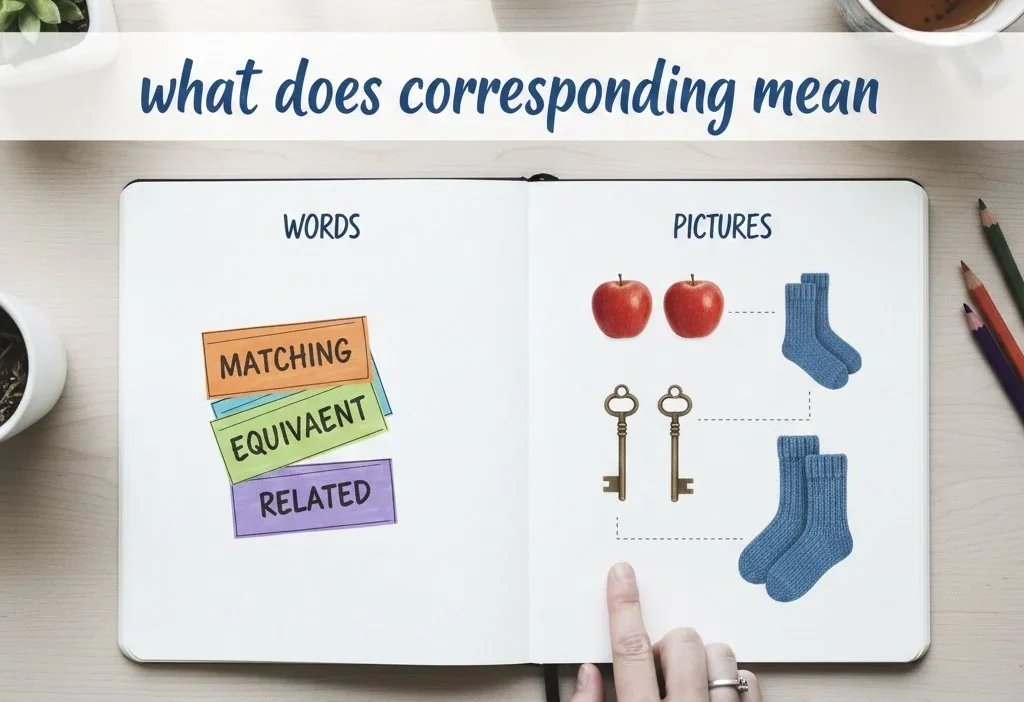
- Matching or equivalent: Something that relates directly to something else.
- Example: “The corresponding page in the second book has the same diagram.”
- Connected or related: Indicating a relationship between two or more things.
- Example: “Her answer was recorded in the corresponding section of the report.”
- Communicating via letters or messages: (verb form: correspond) To exchange information or ideas.
- Example: “They have been corresponding by email for months.”
Quick Tip:
- When you see “corresponding”, think “matching, related, or connected.”
Real-Life Examples
Using corresponding correctly can make your sentences clearer and more professional. Here are some examples in different contexts:
Casual / Daily Use:
- “I wore the corresponding shoes that matched my bag.”
- “Check the corresponding page for the instructions.”
Professional / Academic Use:
- “The corresponding author of the research paper should be contacted for inquiries.”
- “Please ensure the budget entries match the corresponding project codes.”
Texts & Messaging:
- Friend 1: “I think your answer is correct.”
- Friend 2: “Yes, it matches the corresponding solution in the textbook.”
Background & History
Corresponding comes from the verb “correspond”, which has Latin roots: correspondere, meaning “to answer together” or “to be in relation.”
- The term has been in English since the 1600s and originally referred to writing letters and exchanging messages.
- Over time, it evolved to include matching items, related elements, and equivalency in mathematics, science, and daily use.
Fun Fact:
- In older texts, “corresponding” was more formal and primarily used in letters and scholarly works. Today, it’s common in emails, textbooks, reports, and online discussions.
Usage in Different Contexts
Academic and Professional Writing
In essays, reports, or research papers, corresponding is often used to link ideas, data, or references.
Examples:
- “The results were recorded in the corresponding table for each participant.”
- “For each variable, the corresponding statistical analysis was performed.”
Key Notes:
- Always ensure clarity—readers should easily understand what items are corresponding.
- Can also indicate roles: “The corresponding author handles all correspondence about the paper.”
Casual / Everyday Use
In conversation or texting, corresponding can indicate matching items or related ideas.
Examples:
- “I picked the corresponding color for the walls.”
- “Make sure your notes match the corresponding chapters in the textbook.”
Dialogue Example:
Friend 1: “Which shoes go with this outfit?”
Friend 2: “Pick the corresponding pair in black.”
Usage in Messaging & Online Chats
Even online, corresponding is used when talking about matching or related information.
Examples:
- “Your screenshot doesn’t show the corresponding error message.”
- “Can you send the corresponding link to that post?”
Tip:
- This usage is particularly helpful in work chats, gaming instructions, and collaborative projects online.
Professional Communication
Corresponding is a safe word in professional emails, business reports, and official communication.
Common Phrases:
- “The corresponding figures in the report are attached.”
- “Please contact the corresponding department for further assistance.”
Pro Tips:
- Avoid overusing it unnecessarily.
- Ensure readers know what corresponds to what.
Hidden or Misunderstood Meanings
While corresponding is generally neutral, confusion can arise if the connection isn’t clear.
Potential Misunderstandings:
- Ambiguous: “Check the corresponding section.” → Which section? Always clarify.
- Misuse: Using it for unrelated items can confuse readers.
Safe Usage Guidelines:
- Only use when there is a clear, logical connection.
- Combine with context words: page numbers, tables, emails, sections, etc.
Regional & Cultural Variations
- In American English, “corresponding” often appears in academic, professional, or technical writing.
- In British English, it’s also common in formal communication but can appear more frequently in everyday conversation.
- Non-native English speakers may confuse it with correspond, so adding context is crucial.
Comparison With Similar Words
| Word | Meaning | Tone | Usage |
|---|---|---|---|
| Corresponding | Matching, related, connected | Neutral, formal | Academic, professional, casual |
| Related | Connected, linked | Casual/Neutral | Everyday conversation, writing |
| Equivalent | Same value, equal | Formal | Math, science, official documents |
| Matching | Pairs, coordinates | Casual | Fashion, casual conversation |
Key Takeaway:
- Corresponding emphasizes direct relation or connection, while related or matching can be broader or casual.
10 Examples of Corresponding in Different Contexts
- Academic: “Each experiment has a corresponding control group.”
- Professional: “The corresponding invoice was sent to the client.”
- Casual: “Pick the corresponding socks to match your outfit.”
- Texting: “Check the corresponding answer in the textbook.”
- Emails: “Please contact the corresponding person for details.”
- Technical/Engineering: “The corresponding measurements are listed below.”
- Mathematics: “The corresponding angles are congruent.”
- Science: “The corresponding data points are highlighted.”
- Gaming: “Use the corresponding key to unlock the chest.”
- Social Media: “Tag the corresponding post in your comment.”
How to Use Corresponding in Sentences
Here’s a simple formula:
Subject + corresponding + noun
Examples:
- “Please submit the corresponding form by Friday.”
- “The corresponding chart shows monthly sales figures.”
- “Her notes correspond to the corresponding textbook pages.”
Common Mistakes to Avoid
- Using corresponding without clarity → “Check the corresponding page” (which page?).
- Confusing it with unrelated words → “related” vs “corresponding.”
- Overusing in casual conversation → can sound formal or stiff.
Tip: Use in professional, academic, or clear casual contexts.
FAQs
Q1: Can I use corresponding in everyday conversation?
A: Yes, but keep context clear.
Q2: Is corresponding formal or casual?
A: Neutral; slightly formal, but acceptable in casual chats with clarity.
Q3: What’s the difference between corresponding and matching?
A: Matching emphasizes appearance; corresponding emphasizes a direct relation or connection.
Q4: Can corresponding be used in emails?
A: Absolutely. E.g., “The corresponding report is attached.”
Q5: Is corresponding the same as related?
A: Not exactly. Related is broader; corresponding implies a direct link or equivalence.
Conclusion
Understanding what corresponding means helps you communicate more effectively in writing, conversation, and online communication. From academic papers to daily texting, this versatile word signals connection, matching, or relationship. By using it carefully, you make your sentences clearer and more professional, avoiding misunderstandings. Whether you’re a student, professional, or casual texter, knowing the nuances of corresponding will make your communication precise, polished, and confident. So next time you type or read “corresponding,” you’ll know exactly what it refers to and how to use it naturally.