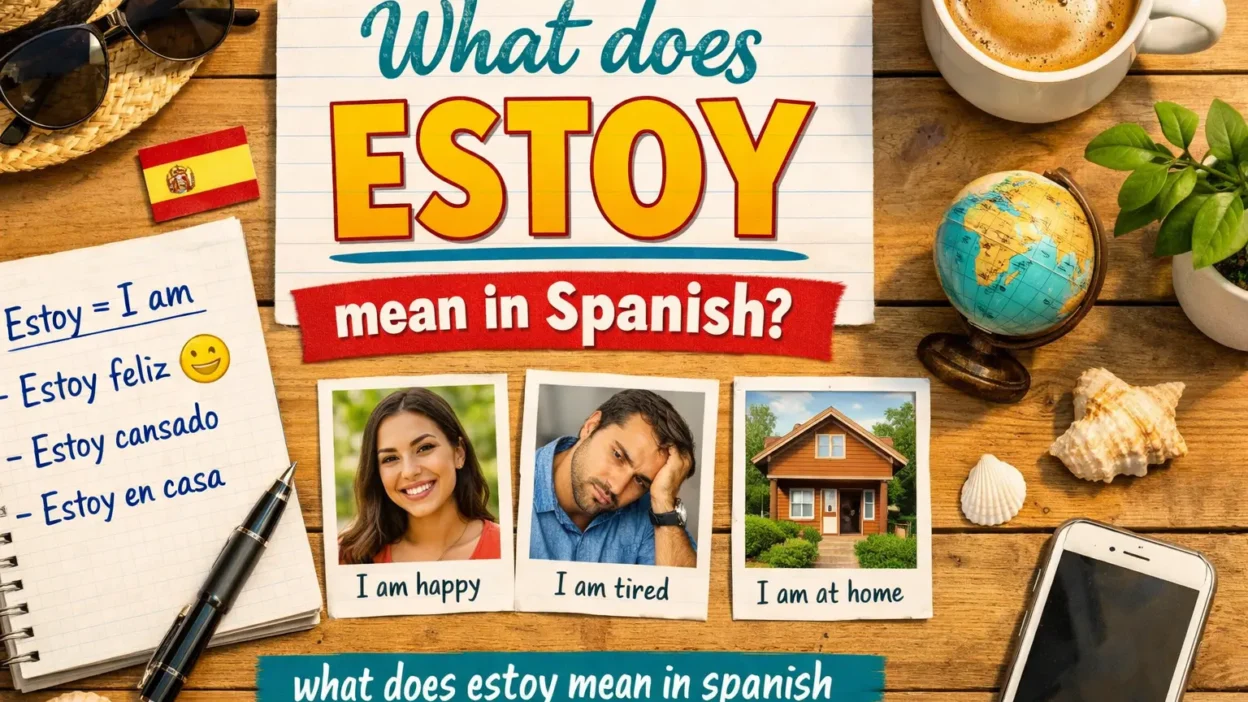
If you’re learning Spanish or scrolling through Spanish captions, chats, or subtitles, you’ve probably seen the word “estoy” pop up everywhere. At first glance, it looks simple — but many learners pause and think, “What does estoy actually mean, and when do I use it?”
That confusion is completely normal. Spanish verbs change depending on who’s speaking and how something feels at the moment. Estoy is one of those words that seems easy but carries a lot of meaning.
In this guide, you’ll learn what estoy means in Spanish, how it’s used in real conversations, examples, common mistakes, differences between estoy and soy, platform usage, FAQs, and a fun quiz at the end.
Quick Answer:
Estoy means “I am” in Spanish, but it’s used for temporary states, feelings, locations, or conditions — not permanent traits.
🧠 What Does Estoy Mean in Spanish?
Estoy is the first-person singular form of the verb estar, which means “to be.” In English, both ser and estar translate to “to be,” but Spanish separates meanings more precisely.
Literal Meaning:
Estoy = I am (temporary or current state)
Example in a sentence:
“Estoy cansado.”
I am tired.
Unlike English, Spanish cares about whether something is temporary or permanent, and estoy always refers to something temporary or changeable.
In short:
Estoy = I am (right now, at the moment, or temporarily).
🌍 Origin and Grammar Behind Estoy
The word estoy comes from the verb estar, which originates from Latin “stare”, meaning to stand or to be situated.
Verb Breakdown:
| Spanish | English |
|---|---|
| Estar | To be (temporary) |
| Estoy | I am |
| Estás | You are |
| Está | He / She is |
| Estamos | We are |
| Están | They are |
Important Grammar Note:
You never use estoy for permanent characteristics like personality, nationality, or identity.
📱 When Do You Use Estoy?
You use estoy in Spanish when talking about temporary conditions, feelings, locations, or states.
Common Uses of Estoy:
1️⃣ Feelings & Emotions
- Estoy feliz — I am happy
- Estoy triste — I am sad
- Estoy nervioso — I am nervous
2️⃣ Physical Conditions
- Estoy cansado — I am tired
- Estoy enfermo — I am sick
- Estoy lleno — I am full
3️⃣ Temporary Situations
- Estoy ocupado — I am busy
- Estoy libre — I am free
- Estoy listo — I am ready
4️⃣ Location
- Estoy en casa — I am at home
- Estoy aquí — I am here
- Estoy en España — I am in Spain
Key Rule:
If it can change, you use estoy.
⚖️ Estoy vs Soy – What’s the Difference?
This is one of the most common Spanish learner questions.
| Estoy | Soy |
|---|---|
| Temporary | Permanent |
| Feelings | Identity |
| Location | Origin |
| Conditions | Personality |
| States | Profession |
Examples:
- Estoy cansado → I am tired (temporary)
- Soy cansado ❌ (incorrect)
- Soy profesor → I am a teacher (permanent)
- Estoy profesor ❌ (incorrect)
Easy Memory Trick:
👉 Estoy = how you feel or where you are
👉 Soy = who you are
💬 Real-Life Examples of Estoy in Conversation
Example 1 – Feeling
A: ¿Cómo estás?
B: Estoy bien, gracias 😊
Example 2 – Location
A: ¿Dónde estás?
B: Estoy en casa 🏠
Example 3 – Temporary Mood
A: ¿Vienes hoy?
B: No, estoy cansado 😴
Example 4 – Situation
A: ¿Puedes hablar ahora?
B: No, estoy ocupado 📞
Example 5 – Emotional State
A: ¿Por qué estás callado?
B: Estoy nervioso 😅
Example 6 – Short Texting Style
- “Estoy aquí.”
- “Estoy listo.”
- “Estoy bien.”
🕓 When to Use and When NOT to Use Estoy
✅ When to Use Estoy
- Feelings and emotions
- Physical or mental conditions
- Temporary states
- Location
- Situations that can change
❌ When NOT to Use Estoy
- Identity
- Nationality
- Profession
- Permanent personality traits
- Physical descriptions that don’t change
Comparison Table:
| Context | Correct Phrase | Why It Works |
|---|---|---|
| Feeling | Estoy feliz | Temporary emotion |
| Location | Estoy en casa | Location |
| Job | Soy médico | Permanent |
| Personality | Soy amable | Identity |
| Mood | Estoy estresado | Temporary |
🌐 How Estoy Is Used Online & in Media
Social Media:
- “Estoy feliz hoy 💙”
- “Estoy cansado del lunes 😭”
Text Messages:
- Short replies: “Estoy bien”
- Status updates: “Estoy ocupado”
Movies & TV:
- Used constantly to show emotions or current situations
Music:
- Common in song lyrics to express feelings “Estoy perdido sin ti…”
🔄 Similar Words or Alternatives
| Word | Meaning | When to Use |
|---|---|---|
| Soy | I am (permanent) | Identity |
| Estoy siendo | I’m being | Temporary behavior |
| Me siento | I feel | Emotions |
| Ando | I’m feeling | Informal |
| Estoy muy | I am very | Emphasis |
Common Mistakes With Estoy
❌ Estoy estudiante
✅ Soy estudiante
❌ Estoy alto
✅ Soy alto
❌ Estoy americano
✅ Soy americano
Tip:
Ask yourself: Can this change?
If yes → estoy
If no → soy
🙋♂️ FAQs About Estoy
1. What does estoy literally mean?
It means “I am”, referring to a temporary state.
2. Can estoy mean location?
Yes. It’s commonly used for location.
3. Is estoy formal or casual?
Both — it works in all situations.
4. Can I use estoy for emotions?
Yes, that’s one of its main uses.
5. Is estoy used in texting?
Yes, very commonly.
6. What tense is estoy?
Present tense.
7. Can estoy be negative?
Yes: No estoy bien.
8. Is estoy ever permanent?
No. That’s when you use soy.
📝 Mini Quiz – Test Your Knowledge
1. What does “estoy” mean?
a) I was
b) I am (temporary) ✅
c) I will be
2. Which sentence is correct?
a) Estoy médico
b) Soy cansado
c) Estoy cansado ✅
3. When do you use estoy?
a) For identity
b) For permanent traits
c) For feelings and location ✅
4. Choose the correct option:
“I am happy”
a) Soy feliz
b) Estoy feliz ✅
5. Which one is wrong?
a) Estoy en casa
b) Estoy nervioso
c) Estoy profesor ❌
📝 Conclusion
The word estoy is essential in Spanish because it allows you to express how you feel, where you are, and what condition you’re in right now. While it translates to “I am,” its meaning goes deeper than English. Understanding when to use estoy instead of soy is one of the biggest steps toward speaking Spanish naturally.
Once you master estoy, your Spanish will sound more fluent, accurate, and confident — whether you’re texting, traveling, or learning through conversation.