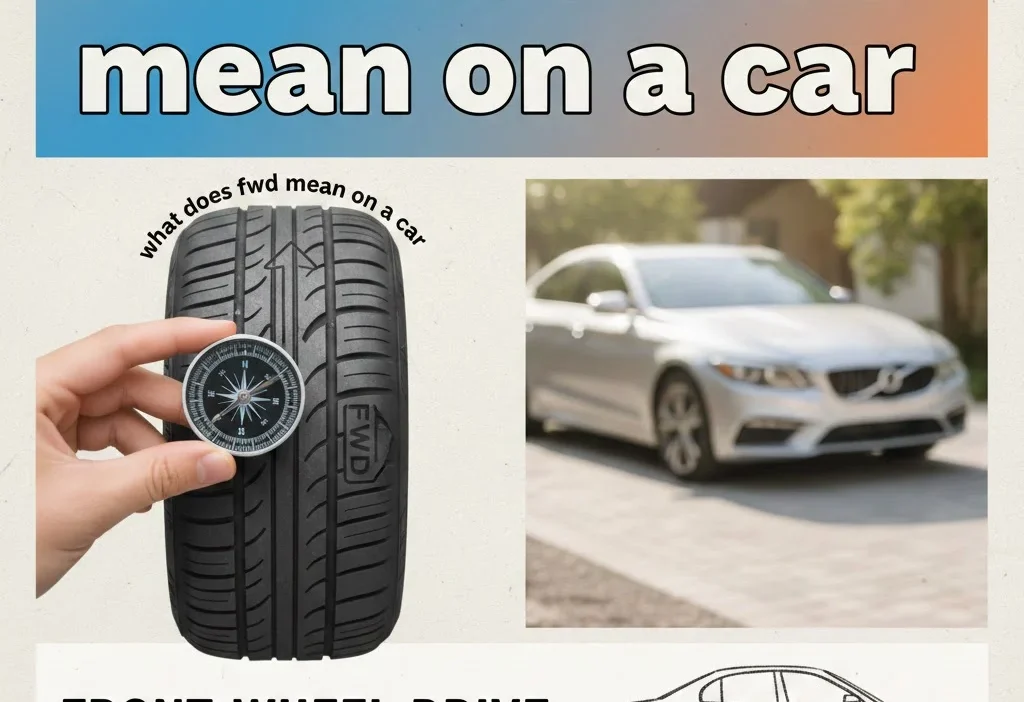
If you’ve ever browsed car listings, watched reviews, or talked with a mechanic, you’ve probably seen the term FWD. Many people nod and pretend they know what it means, but deep down they’re thinking: “What exactly is FWD on a car?” I had the same confusion until a friend explained it when I asked why his car drove differently in the rain.
Today, you’ll get that same clarity — but way simpler.
Quick Answer:
FWD means “Front-Wheel Drive.” It’s a system where the front wheels receive the engine’s power, making the car easier to control, fuel-efficient, and beginner-friendly — especially in normal weather.
🧠 What Does FWD Mean on a Car?
FWD (Front-Wheel Drive) is a drivetrain system in which only the front two wheels power the vehicle.
They handle both steering and pulling the car forward.
So when you press the gas pedal, it’s the front wheels doing the work.
Example Explained:
When driving a FWD car, the engine pulls the car instead of pushing it, creating smoother and predictable control.
In short:
FWD = Front-Wheel Drive = The front wheels move and steer the car.
This design makes FWD cars easy to drive, especially for beginners.
🚗 How FWD Works (Simple Breakdown)
Instead of complicated mechanical diagrams, here’s a simple explanation:
- The engine power is sent to the front wheels.
- The front wheels pull the car forward.
- Since the front wheels already steer, doing both jobs keeps the system simple.
Why Most Modern Cars Use It:
✔ Cheaper to build
✔ Great fuel economy
✔ Better for everyday drivers
✔ Safer on slippery roads
📍 Where Is FWD Commonly Found?
You’ll find FWD used in:
- 🚘 Sedans (Toyota Corolla, Honda Civic)
- 🚗 Compact cars (Nissan Sentra, Kia Forte)
- 🚙 Small SUVs/Crossovers (Honda CR-V, Toyota RAV4 base models)
- 💰 Budget-friendly cars
- 🛣 Daily commuting vehicles
Is FWD casual or professional?
It’s best for everyday use, family driving, and urban commuting — not racing or off-road adventures.
💬 FWD vs Other Drive Systems (Quick Comparison)
To understand FWD better, here’s how it stacks up:
| System | Power Sent To | Best For | Weather Performance |
|---|---|---|---|
| FWD | Front wheels | Daily driving | Good in rain |
| RWD | Rear wheels | Sports cars | Weak in snow |
| AWD | All wheels | All conditions | Excellent |
| 4WD | All wheels (selectable) | Off-road | Best for rough terrain |
🤔 Why Choose FWD? (Benefits)
FWD cars offer strong advantages:
✔ Better traction on wet roads
The front wheels hold the engine’s weight, pushing down on the tires for grip.
✔ Excellent for city driving
Simple steering and predictable movement.
✔ Fuel-efficient
Fewer moving parts = less wasted energy.
✔ Lower maintenance cost
It’s cheaper to repair than AWD, RWD, or 4WD systems.
⚠️ Downsides of FWD
No drivetrain system is perfect. Here are FWD drawbacks:
❌ Not ideal for high-speed performance
Rear-wheel drive cars handle sporty driving better.
❌ Tires wear faster in front
Because steering + power both go to the front wheels.
❌ Limited on steep terrains
Better for roads, not mountain trails.
📊 Is FWD Good in Snow or Rain?
Yes — usually.
Because the engine weight sits above the front wheels, they get better traction in slippery weather. It’s not perfect, but much better than RWD in snow.
Drivers often say:
“If you live where it rains or snows, FWD is safer and easier.”
🔄 Real-Life Example Scenarios
| Situation | Best Option | Why it Works |
|---|---|---|
| Daily City Driving | FWD | Good mileage, easy handling |
| High-Speed Racing | RWD | Better cornering |
| Snowy Roads | FWD or AWD | More traction |
| Off-road Adventure | 4WD | Designed for tough terrain |
🆚 FWD vs AWD vs RWD (Deep Dive)
➤ FWD (Front-Wheel Drive)
- Best for beginners
- Great fuel economy
- Affordable maintenance
➤ AWD (All-Wheel Drive)
- All tires get power
- Best for snow, ice, steep hills
➤ RWD (Rear-Wheel Drive)
- Performance-focused
- Used in muscle cars and racing vehicles
🛠️ Does FWD Need Special Maintenance?
No special care is required, but keep an eye on:
✔ Front tire tread
✔ Alignment
✔ Suspension
✔ Brakes
Because front wheels work harder, these parts get more stress.
💬 Common Mistakes People Make About FWD
- ❌ “FWD is weak” — Nope, it’s strong enough for daily driving.
- ❌ “FWD can’t handle rain” — Actually, it performs well in rain.
- ❌ “FWD is only for cheap cars” — Many modern SUVs use FWD.
⭐ Pros and Cons Summary Table
| Category | FWD Strength |
|---|---|
| Cost | ⭐⭐⭐⭐ (Very Affordable) |
| Fuel Efficiency | ⭐⭐⭐⭐ |
| Handling | ⭐⭐⭐⭐ |
| Performance | ⭐⭐ |
| Snow Stability | ⭐⭐⭐ |
🙋♂️ FAQs About FWD
1. Is FWD better than AWD?
For city driving and fuel economy, yes. For snow and mountains, AWD wins.
2. Is FWD good for beginners?
Absolutely. It’s easier and safer to handle.
3. Do FWD cars last long?
Yes — fewer parts = fewer problems.
4. Can FWD race?
Not ideal; RWD is better for performance.
5. Are FWD cars cheaper to fix?
Yes, maintenance is generally lower.
📝 Mini Quiz — Test Your Knowledge!
1. What does FWD stand for?
a) Fast-Wheel Drive
b) Front-Wheel Drive ✅
c) Forward Drive
2. Which wheels receive power in FWD?
a) Rear wheels
b) Front wheels ✅
c) Both
3. FWD cars are best for:
a) Daily commuting ✅
b) Off-road racing
c) Mountain drifting
4. Which is better in snow?
a) RWD
b) FWD or AWD ✅
c) None
5. Are FWD cars fuel-efficient?
a) Yes ✅
b) No
🧾 Conclusion
FWD stands for Front-Wheel Drive, a system where the front wheels power and steer the vehicle. It’s fuel-efficient, budget-friendly, and safe in everyday driving conditions, especially rain or light snow. Whether you’re a first-time driver or commuting daily, FWD is reliable, smart, and easy to maintain.