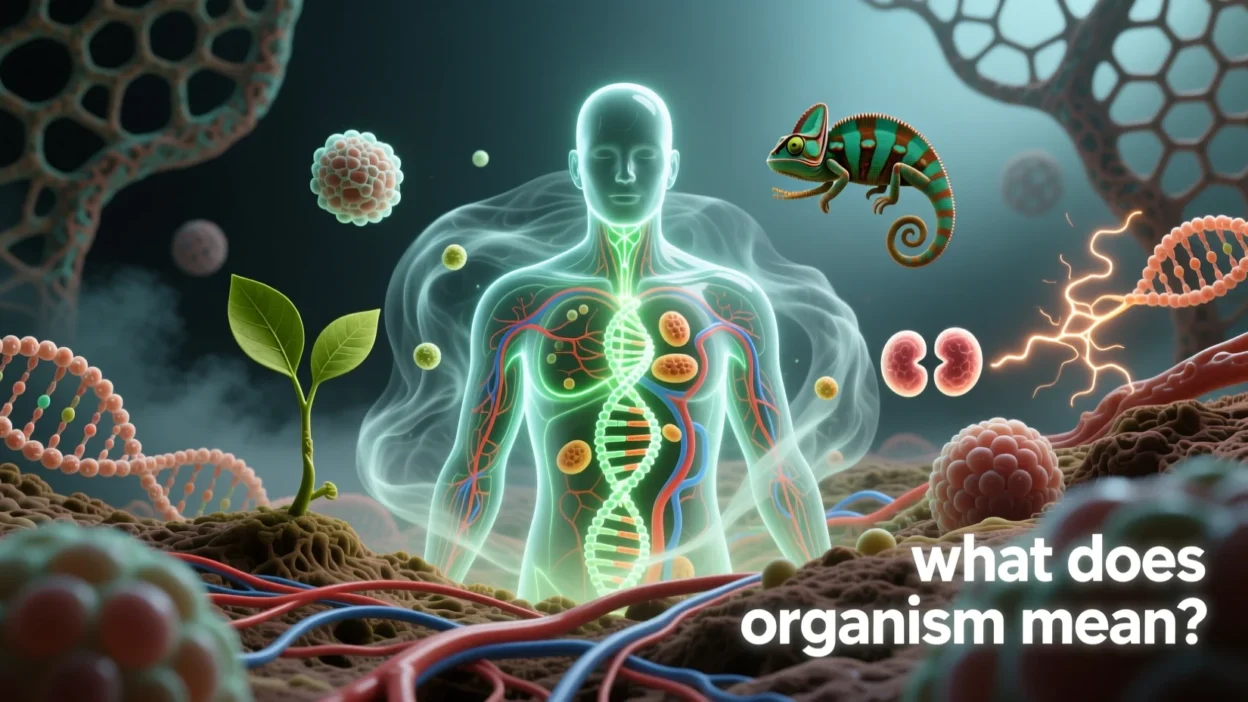
If you’ve ever read a biology book, watched a science video, or heard someone talk about life forms, you’ve likely come across the word organism. But what does it really mean? And why is this term so important in science, classrooms, and everyday conversations?
Whether you’re a student, a curious reader, or someone preparing content, understanding the organism meaning can make biology feel much simpler and more interesting. This guide breaks down the definition, examples, types, history, and FAQs in a way that’s easy to read and perfect for beginners.
Let’s start with the quick definition.
Quick Answer
Organism Definition:
An organism is any living thing — a plant, animal, human, fungus, bacterium, or tiny microscopic life form.
Simple Example:
- A tree = an organism
- A dog = an organism
- A mushroom = an organism
- Even bacteria on your skin = organisms
Other terms: organism meaning, organism in biology, organism definition for students, types of organisms
Organism Definition & Meaning (Simple + Scientific)
An organism is a living being that can grow, reproduce, respond to the environment, and carry out life processes.
In biology, organisms include everything from large animals to tiny microscopic bacteria.
Any organism can:
- Eat or absorb nutrients
- Grow
- Reproduce
- Respond to stimulus (light, heat, touch, danger)
- Maintain internal balance (homeostasis)
Real-Life Examples:
- Animals: Humans, cats, birds, insects
- Plants: Roses, pine trees, grass
- Microorganisms: Bacteria, amoeba, algae
- Fungi: Mushrooms, yeast
Quick Dialogue Example:
- Student: “Is a mushroom an organism?”
- Teacher: “Yes! Anything alive and functioning is an organism.”
Synonyms & Related Terms:
- living being
- life form
- biological entity
- living organism
Background & History of the Word “Organism”
The word organism comes from the Greek word organon, meaning “tool” or “instrument.” Early scientists used it to describe living systems that work through organized structures and functions — like tools with specific purposes.
How the concept evolved:
- 1700s: Early biologists used “organism” to describe living things with organs or organized structures.
- 1800s: With microscopes, scientists discovered bacteria and realized organisms can be tiny too.
- 1900s: The definition expanded to include cells, genetics, and evolution.
- Today: An organism is any living system, big or small, simple or complex.
Modern biology recognizes millions of organisms, from deep-sea creatures to microscopic organisms in soil.
Usage in School, Science, and Everyday Life
Here’s how the word “organism” appears in different places:
| Place | Example | Meaning |
|---|---|---|
| Biology class | “An organism must carry out life functions.” | Scientific definition |
| Health science | “The human body is a complex organism.” | Medical/biological model |
| Environmental talks | “Organisms depend on their ecosystem.” | Ecological context |
| Everyday life | “That tiny bug is a living organism.” | Simple, common meaning |
Tip: Anytime you’re talking about anything that lives, the word organism is correct.
Is “Organism” Used in Professional Fields?
Yes — the term is common in science, healthcare, research, and environmental studies.
Used in professional contexts like:
- Biology
- Microbiology
- Medicine
- Ecology
- Genetics
- Environmental science
Professional Example:
- “This organism thrives in warm environments.”
- “We isolated the organism causing the infection.”
Safer Alternatives for Beginners:
- “Living thing”
- “Life form”
- “Living being”
Other / Hidden Meanings of Organism
While the scientific meaning is the main one, “organism” can also be used more broadly:
- Metaphorical: “The company works like a living organism.”
- Philosophical: Refers to any interconnected system with structure and function.
- Cellular focus: Sometimes used to describe single-celled organisms like bacteria or amoeba.
Comparison Table:
| Term | Meaning | Example |
|---|---|---|
| Organism | Any living thing | Human, plant, bacteria |
| Cell | Basic unit of life | Red blood cell |
| Species | Group of similar organisms | Dogs, cats |
| Ecosystem | Area where organisms interact | Forest, ocean |
Best Practices for Understanding the Term
When to use the word organism:
- When describing anything that is alive
- When writing school essays or biology homework
- When explaining life processes
When to avoid or simplify:
- When talking to kids → use “living thing”
- In casual conversation → “plant,” “animal,” “germ” may be clearer
Tips for clarity:
- Pair the word with an example (“The organism, like a cat…”)
- Use more specific terms when possible (“fungus,” “bacterium,” etc.)
Types of Organisms (Quick Breakdown)
Common organism categories:
- Animals
- Plants
- Fungi
- Bacteria
- Archaea
- Protists (like amoeba)
Simple Examples:
- Cat = animal organism
- Rose = plant organism
- Mushroom = fungal organism
- Amoeba = single-celled organism
How to Explain “Organism” in Different Styles
Casual:
- “An organism is anything alive — animals, plants, even tiny germs.”
For kids:
- “If it grows, eats, or breathes, it’s an organism.”
Scientific:
- “An organism is a living system capable of metabolism, reproduction, and response to stimuli.”
Funny:
- “If it eats your snacks or bites your leg, it’s an organism.”
Simple:
- “Organism = living thing.”
Regional & Cultural Notes
- In Western countries, “organism” is a common school word.
- In Asian schools, translations of organism are used more frequently.
- In scientific communities worldwide, the definition is universal.
FAQ About Organisms
1. What does organism mean in simple words?
A living thing — like a plant, animal, or tiny germ.
2. Is a virus an organism?
Most scientists say no because viruses cannot reproduce on their own.
3. Is a human an organism?
Yes — humans are complex organisms made of trillions of cells.
4. Are plants organisms?
Yes. Trees, flowers, grass, and shrubs are all organisms.
5. Are bacteria organisms?
Yes — they are single-celled organisms.
6. What are the basic features of an organism?
Growth, reproduction, responding to the environment, gaining energy.
7. Can one cell be an organism?
Yes — organisms like amoeba and bacteria are single-celled but fully alive.
Conclusion
An organism is simply any living thing, big or small. From humans and trees to microscopic bacteria, every organism carries out life processes like growth, energy use, and reproduction. Understanding the meaning of organism helps you grasp biology, ecosystems, and how life works on Earth.
Whether you’re studying, teaching, or just curious, remembering that “organism = living thing” makes everything simpler.