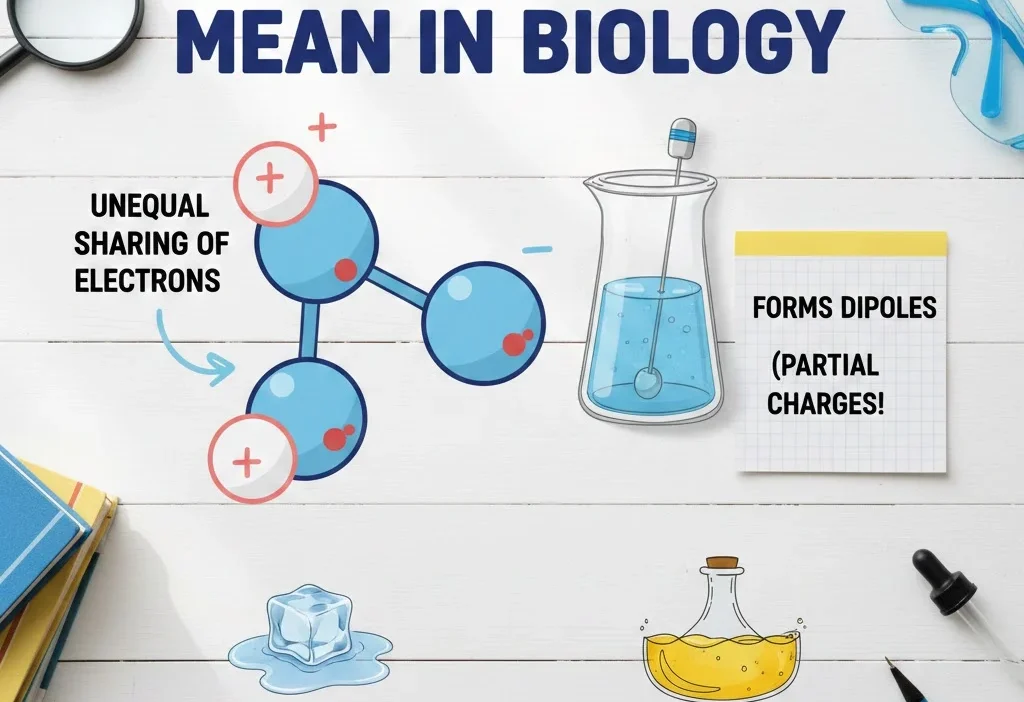
Have you ever come across the term “polar” in a biology class or textbook and wondered what it really means? Maybe you saw it in a diagram of molecules, cells, or even ecosystems, and the explanation felt confusing. You’re not alone — biology uses the word in several contexts, and understanding it is key to grasping fundamental concepts.
This guide explains what polar means in biology, its definition, types, examples, importance, related terms, and FAQs. By the end, you’ll confidently understand how and why “polar” is used in biology.
Quick Answer:
In biology, “polar” describes molecules, cells, or structures that have uneven distribution of charges or properties. It’s a scientific and precise term used to explain chemical behavior, cellular structures, or biological polarity.
🧠 What Does Polar Mean in Biology?
In biological terms, polar refers to a property of molecules, cells, or regions where there is an uneven distribution of electrical charge or distinct structural differences. The term comes from the idea of “poles” — just like the north and south poles, polar ends have opposite properties.
Examples of polar contexts in biology:
- Polar molecules – Molecules with regions of positive and negative charge, such as water (H₂O). “Water is a polar molecule, which allows it to form hydrogen bonds.”
- Cell polarity – Cells having structurally or functionally distinct regions, like neurons or epithelial cells. “Polar cells have different functions at their apical and basal ends.”
- Polar organisms or ecosystems – Organisms adapted to polar regions (Arctic and Antarctic). “Polar bears thrive in the polar ecosystem of the Arctic.”
In short:
Polar = Uneven distribution of charges or properties = Molecules, cells, or organisms with distinct poles or regions.
🌍 Types of Polar Structures in Biology
1. Polar Molecules
- Molecules with positive and negative ends
- Example: Water (H₂O), Ammonia (NH₃), Ethanol (CH₃CH₂OH)
- Importance: Influences solubility, chemical reactions, and biological interactions
2. Polar Cells
- Cells with structural or functional differences at opposite ends
- Example: Epithelial cells – apical (top) vs basal (bottom) surfaces
- Importance: Crucial for cellular communication, nutrient transport, and tissue formation
3. Polar Ecosystems
- Regions near Earth’s poles: Arctic and Antarctic
- Organisms adapted to extreme cold, seasonal light, and ice
- Example: Polar bears, penguins, seals, krill
📱 Where Is Polar Commonly Used in Biology?
Polar is used in multiple fields of biology and life sciences:
- 🧪 Biochemistry – Describing polar molecules and hydrogen bonding
- 🧬 Cell Biology – Explaining cell polarity and asymmetric cell division
- 🌡️ Ecology – Discussing polar ecosystems and adaptations
- 🌊 Marine Biology – Studying polar marine organisms and food chains
- 🧫 Microbiology – Bacterial cell polarity for division and function
Tone: Scientific, precise, educational.
Not used: Casual conversations or non-scientific contexts without clarification.
💬 Real-Life Examples of Polar in Biology
- Molecules:
“Water is polar, so it dissolves salts efficiently.”
- Cells:
“Neuron cells are polar; dendrites receive signals, axons transmit them.”
- Ecosystems:
“Polar regions are home to specialized organisms like polar bears and krill.”
- Chemical interactions:
“Polar molecules interact through hydrogen bonds, influencing protein folding.”
- Plant biology:
“Auxin distribution in polar transport regulates plant growth.”
🕓 When to Use & When NOT to Use “Polar” in Biology
✅ When to Use Polar
- Describing molecules with uneven charge distribution
- Explaining cell structure and polarity
- Discussing organisms in polar regions
- In scientific writing, lectures, or educational materials
- Explaining chemical interactions in biological systems
❌ When Not to Use Polar
- Casual texts without context
- Non-scientific discussions about the weather (unless specifying polar regions)
- Describing non-polar objects incorrectly
- Mislabeling organisms or molecules as polar without evidence
- Everyday conversations where “polar” would confuse listeners
Comparison Table
| Context | Example Phrase | Why It Works |
|---|---|---|
| Biochemistry | “Water is polar, ethanol is polar.” | Accurate description of molecules |
| Cell Biology | “Epithelial cells are polar.” | Correct structural description |
| Ecology | “Polar bears live in polar regions.” | Geographic and organismal accuracy |
| Casual Text | “That object is polar.” | Avoided; scientifically unclear |
| Research Paper | “Polar molecules form hydrogen bonds.” | Formal and precise |
🔄 Similar Terms or Related Concepts
| Term | Meaning | When to Use |
|---|---|---|
| Non-polar | Molecules without charged ends | Contrast with polar molecules |
| Hydrophilic | Water-loving, often polar | Biochemistry, molecular biology |
| Hydrophobic | Water-fearing, often non-polar | Molecular interactions |
| Apical | Top surface of a cell | Cell polarity |
| Basal | Bottom surface of a cell | Cell polarity |
| Dipole | Separation of positive and negative charges | Chemistry/biology discussions |
🙋♂️ FAQs About Polar in Biology
1. What does polar mean in biology?
Polar refers to molecules, cells, or regions that have distinct ends or uneven charge distribution.
2. What is an example of a polar molecule?
Water (H₂O) is the most common polar molecule in biology.
3. How does polar affect cells?
It explains cell polarity, where different parts of a cell perform distinct functions.
4. What organisms are polar?
Polar organisms live in Arctic or Antarctic ecosystems, e.g., penguins and seals.
5. How does polar impact chemistry?
Polar molecules form hydrogen bonds, affecting solubility, reactions, and protein structures.
6. Is polar always positive or negative?
No, it indicates a difference in charge distribution, not absolute positive or negative.
📝 Mini Quiz – Test Your Knowledge
1. What does polar mean in biology?
a) Even distribution of charges
b) Uneven distribution of charges ✅
c) Color of cells
2. Which of these is a polar molecule?
a) Oil
b) Water ✅
c) Methane
3. What is an example of polar cell polarity?
a) Neuron cells ✅
b) Red blood cells
c) Platelets
4. Which of the following organisms live in polar regions?
a) Penguins ✅
b) Kangaroos
c) Lions
5. Polar molecules are usually:
a) Hydrophobic
b) Hydrophilic ✅
c) Non-reactive
📝 Conclusion
In biology, polar is a key concept that explains everything from molecular interactions to cell function and ecosystem adaptations. Understanding polarity allows students, researchers, and enthusiasts to predict behavior of molecules, describe cells accurately, and appreciate life in extreme environments like the Arctic and Antarctic. Whether in chemistry labs, biology classrooms, or field studies, knowing what polar means is essential for scientific literacy.